Master blaster Sachin Tendulkar, the God of Cricket, the epitome of performance and a legend in world cricket, with a whole nation swearing by him…. India can’t be more proud.
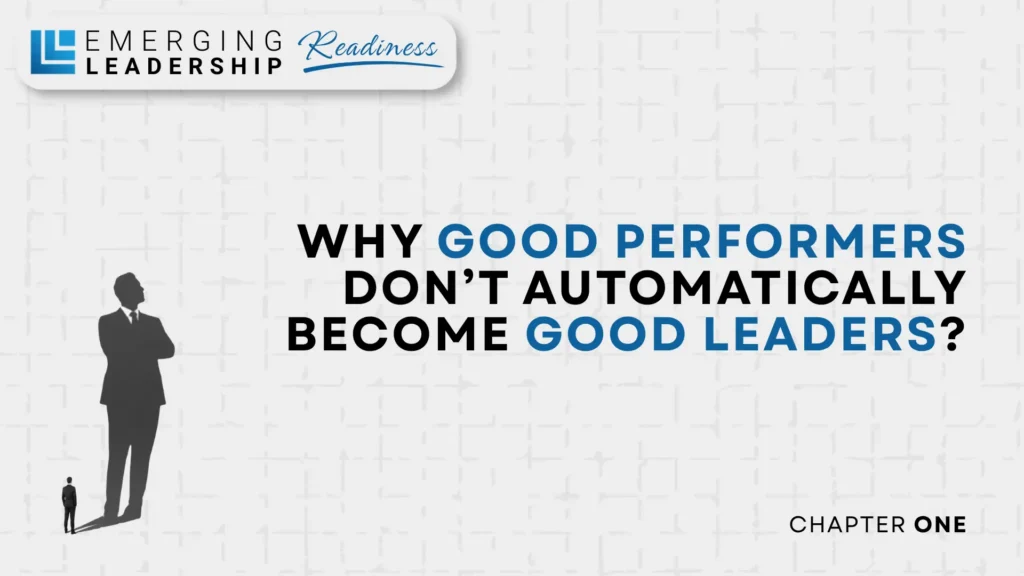
But his brilliance as a batsman could not automatically elevate him as one of world’s best cricket captains. Reason? Leadership required something more than personal excellence, be it on field or off it.
A captain not just manages his own performance, but needs to manage people – their confidence, form, emotions, energy, roles, pressure, and alignment.
It’s a very different ballgame. Sachin could carry the bat effortlessly. But leadership required him to carry people.

Dive in to the corporate pitch. The scenario resonates. The best developer elevated as a tech lead, the best delivery manager becomes delivery head, the best salesperson becomes sales head, the best operations person is now the operations lead, heightened expectations… great indeed!
Earlier, they were rewarded for their own performance. Now, they are expected to create performance through others.
More often than not, nobody tells them clearly that, the game hasn’t changed. What changed is the perspective; it has become more inclusive rather than exclusive. His performance will still be rewarded, but now as a team-lead.
This is the uncomfortable truth inside many growing companies:
Your most trusted performer may become your next leadership bottleneck.
Not because they are incapable. But because everyone assumes they are ready.
Whenever I meet founders, I notice one common pattern. Whether the challenge is with themselves or with their team, most founders do not initially see themselves as part of the problem. The finger usually points to the next level of leadership.
“The team is not taking ownership.”
“They are not thinking deeply.”
“They still come back to me for every decision.”
“They are good people, but they are not ready.”
And many times, they are right. But I usually start from the top.
If a founder has not been able to create an effective second line of leadership over the years, it may also indicate that some shift is required in the founder’s own thinking, style, or way of working. Because leadership teams are not created only by promotion, they are created by clarity, trust, coaching, space, and conscious development.
Once the founder starts seeing this, the real work begins. And that is when a deeper truth appears. The founder may be sitting on a volcano.

If you are a founder and your next level of leadership is weak or almost non-existent, this blog series is for you. If you have been running a business for decades and now want to hand it over to your son or daughter, but they do not seem fully ready, this series is for you.
If your company has grown because of your personal speed, energy, and decision-making, but the next line still depends heavily on you, this series is definitely for you.
Let us look at a typical scenario.
Every organization has a few people who quietly become very important to the business. They are the High Performers.
They are sincere, dependable, hardworking, and trusted. They understand the work, deliver consistently, and often become the people the founder or senior leadership team relies on. So when the company grows and the need for the next line of leadership emerges, these high performers become the natural choice.
They are promoted. They start leading a team. They are the Emerging Leaders.
And that is where the real test begins. Because the same person who was excellent as a high performer may start struggling as an emerging leader.
They may continue to work hard, but the team may not move with the same speed. They may remain committed, but delegation may become difficult. They may take responsibility, but still look to the founder for direction, approval, or confidence.
At first, this may look like a capability issue. But most of the time, it is a Transition Issue.
The designation changes first. The mindset changes much later. That gap is where most emerging leaders struggle.
| High Performer | Emerging Leader |
| Focuses on completing own work well | Focuses on creating outcomes through people |
| Asks, “What do I need to complete?” | Asks, “What outcome needs to be created?” |
| Gets appreciated for being hands-on | Gets valued for building ownership in others |
| Solves problems personally | Builds people who can solve problems |
| Waits for direction when unclear | Creates clarity when things are unclear |
| Owns tasks | Owns outcomes |
This shift is simple to understand, but difficult to live.
For years, high performers are praised for being hands-on, available, fast, and dependable. Then all of a sudden, post promotion, they are expected to step back, delegate, guide, think ahead, manage people, and build ownership in others.
They continue playing the old game with a new title. This is where founders start feeling frustrated. “I promoted this person because they were so good. Why is everything still coming back to me?”
And the emerging leader may also feel stuck. “I am trying my best, but I am not fully sure what is expected from me now.”
The real issue is not lack of intent. The real issue is lack of leadership preparation.
The biggest shift an emerging leader must make is from doing the work to owning the outcome.
This means they must stop seeing themselves only as task-completers and start seeing themselves as people who create clarity, develop others, manage priorities, influence stakeholders, and ensure results.
This is uncomfortable because doing gives instant satisfaction. Leadership often does not.
You may spend time clarifying direction, coaching someone, aligning stakeholders, preventing a future problem, or delegating something you could have done faster yourself. In the beginning, it may not feel like “real work.”
But that is leadership work. And without this work, the team remains dependent.
Many high performers struggle after promotion because they continue to remain the best doer in the team. They take work back into their own hands because it feels faster. They avoid difficult conversations because they do not want to upset people.
They remain reactive because they are used to responding to tasks, not shaping priorities. None of this means they cannot become strong leaders. It only means leadership cannot be left to chance.
Time alone does not build leadership. Experience helps only when it is supported by reflection, feedback, mentoring, and conscious practice. Otherwise, people may spend years repeating the same performer habits with a leadership title.
And the company pays the price quietly. Decisions keep moving upward. Teams remain dependent.
Founders stay trapped in daily operations. Growth slows down, not because the business lacks opportunity, but because the leadership layer is not ready to carry it.
Leadership is not about seniority. It is about maturity.
It is about thinking beyond oneself. It is about making decisions in ambiguity. It is about owning both the problem and the solution.
It is about moving from “my work” to “our outcome.”
There is a beautiful thought often associated with leadership: “Being a leader does not mean dominating the situation. It means empowering people to do what they would not have imagined possible.”
That, for me, captures the real shift.

How BCCI solved the Captaincy Conundrum
Earlier, BCCI looked for one national cricket king.
From Sachin to Dhoni, the question was:
Who can carry Indian cricket?
From Kohli to Rohit, it became:
Who can manage pressure, media, seniors, and ICC expectations?
Now, with Gill and the split-format ecosystem, the question is:
Who fits the format, timeline, commercial future, and 2027–2030 cycle?
Sachin was the burdened genius.
Ganguly was the rebel builder.
Dravid/Kumble were the ethical stabilisers.
Dhoni was the instinctive disruptor.
Kohli was the intensity engine.
Rohit was the cooling system.
Gill is the succession project.
BCCI has gradually stopped choosing captains only by greatness. It now chooses by succession value, format relevance, age profile, public acceptability, dressing-room control, and tournament horizon. The latest Gill move is not just about captaincy; it is BCCI saying: the next decade must be built now, even if Rohit and Kohli are still around as players.
Do your Next Level Leadership Readiness Check (Download the Excel workbook here): https://bit.ly/3SGvlvx
So, if you are a founder or CEO, pause and look at your second line of leadership. Are they good performers with bigger titles? Or are they becoming leaders who can think, decide, own, and execute independently?
Are they reducing dependence? Or are they becoming another layer through which dependence is simply passing back to you?
And if you yourself are an emerging leader, ask yourself one honest question: Am I still trying to prove myself by doing more, or am I learning to create outcomes through others?
Because the journey from performer to leader does not begin with a promotion letter. It begins with an inner shift.
From: “I am responsible for my work.”
To: “I am responsible for creating outcomes.”
That is where emerging leadership truly begins.
In the next six blogs, I will share what it really takes for a high-performing professional to justify the trust placed in them and grow into an emerging leader the founder or CEO can depend on.
Not only to run the day-to-day work of the organization, but also to create new opportunities for growth, work with other leaders, and contribute to the business like part of a well-oiled leadership machine.
Next, we will explore the first real leadership muscle that many people ignore: Clarity.
Because unclear leaders do not create ownership. They create dependence.
Till the next blog, Keep Smiling.