Devdutt Pattanaik shares a beautiful story of Narad and Garuda that explains ownership better than many management books.
One day, Narad asked Vishnu why Garuda’s image was placed before Vishnu in temples, and not Narad’s. After all, Narad was also a great devotee. Before Vishnu could answer, there was a loud crash outside Vaikuntha. Vishnu asked Narad to check what had happened. Narad went out, came back, and said, “A milkmaid fell.”
Vishnu asked, “What is her name?” Narad went again and came back with the answer. Then Vishnu asked, “Where was she going?” Narad went again. Then Vishnu asked, “Why did she fall?” Narad went again. Then Vishnu asked, “Did the pot break?” Again, Narad had to go back and check.
This continued for some time. Every time Vishnu asked one more question, Narad went out, got that specific answer, and came back. Narad was obedient, sincere, and devoted. He did exactly what he was asked to do. But he was only answering what was asked. He was reacting.
Then Garuda came back. Vishnu asked Garuda the same thing: “There was a crash outside. Can you check what happened?” Garuda went once and came back with the complete picture.
He said the milkmaid’s name was Sharada. She was going to the market. A snake crossed her path. She got startled and fell. One of her two pots broke. She was worried about the loss of the broken pot and the spilt milk. Garuda had also suggested that she sell the remaining milk to Vishnu, since Vishnu was married to Lakshmi, the goddess of wealth.
When Vishnu asked the price, Garuda already knew that too. That is when Narad understood why Garuda was valued so much.
That is the real difference between responsibility and ownership.

The Problem: Everyone Wants Ownership, Few Understand It
The ownership conversation is not merely a matter of organisational etiquette. Gallup estimates that only one in five employees globally was engaged at work in 2025, with low engagement costing the world economy nearly US$10 trillion in lost productivity. India’s engagement level stood at 23%, with the productivity loss estimated at approximately US$351 billion. Ownership cannot solve disengagement by itself, but both problems begin with the same question: do people see themselves as participants in an outcome, or merely occupants of a role?
Every organization wants people like Garuda. Founders want them. CEOs want them. Managers want them. Clients want them.
Ownership is written on office walls. It appears on company websites. It is proudly displayed in profile decks. It is mentioned in appraisal forms, town halls, and leadership conversations.
Yet, on the ground, ownership remains one of the biggest problems inside organizations.
That is the dichotomy.
The word is visible everywhere, but the behaviour is missing where it matters most.
This is especially important for emerging leaders. At the early stage of leadership, many people believe that promotion comes from performance alone. But as they grow, their role is no longer just to complete tasks but to own outcomes, build trust, solve problems, and reduce the follow-up burden on their manager.
A good performer asks, “What should I do?” An emerging leader asks, “What outcome needs to be achieved?” That is where the real shift begins.
Many founders quietly say, “If only people took ownership of their roles, I could sleep peacefully.” Behind that sentence sits years of chasing, reminding, correcting, following up, and stepping in at the last moment.
The strange thing is that most people do not think they lack ownership. They usually believe they are responsible. They believe they are doing their job. They believe the problem is somewhere else.
The instructions were unclear. The client changed the requirement. The team did not support. The system was weak. The manager did not explain. The other department delayed. There was too much work. There was not enough time.
Some of these reasons may even be true. But ownership begins at the exact point where blaming ends.
Blame is like termites. It does not always make noise in the beginning. It quietly enters the system through one delayed response, one missed deadline, one excuse, one “I did not know,” one “I was busy,” one “the team did not do it,” or one “the client was unclear.”
At first, these look like small behaviours. But slowly, they start eating the foundation of trust. And when trust weakens, everything becomes expensive.

Emerging leaders must learn to move from instructions to outcomes. But organisations must also recognise that ownership cannot grow inside chronic ambiguity. Gallup has found that only about half of employees strongly understand what is expected of them, while employees whose real work aligns with their stated role are 2.5 times more likely to be engaged. Ownership therefore begins with two complementary responsibilities: the manager creates clarity; the employee converts that clarity into action.
The Impact: Weak Ownership Quietly Makes Everything Costlier
The cost of weak ownership rarely appears under a separate line item in the balance sheet. It appears as rework, missed follow-ups, preventable escalation, absenteeism, customer frustration and management time. Gallup’s global research shows that highly engaged teams outperform their least-engaged counterparts by 23% in profitability, 18% in sales productivity and 14% in production productivity, while also recording substantially lower absenteeism and quality defects. Ownership is not the only reason for this difference, but it is one of the behaviours through which engagement becomes performance.
Time becomes expensive because managers start following up instead of leading. Money becomes expensive because invoices are delayed, proposals are not sent, delivery timelines slip, and opportunities are missed. Credibility becomes expensive because people stop trusting commitments. Culture becomes expensive because one person’s lack of ownership becomes another person’s extra burden.
Not taking ownership does not always look dramatic. It often looks very normal.
A manager gives work to a team member. The team member does not ask clarifying questions. The work does not get done on time. The manager has to follow up again and again. Finally, the manager gets involved and completes the work.
On the surface, it looks like a small delay. At a deeper level, ownership was missing.
If your manager, client, or stakeholder has to repeatedly call you to check the status of something you committed to, it is usually a sign that ownership has not been taken. For emerging leaders, this is one of the most important signals to notice.
If your manager has to keep asking, “What is the status?” ownership has already weakened. If your client has to remind you, trust has already reduced. If your team has to wait because you did not close the loop, leadership has already been affected.
Ownership is not only about doing the task. It is about understanding the importance of the task, clarifying expectations, communicating progress, anticipating risks, and closing the loop without being chased.
Follow-up is not free. It consumes a managerial resource that is already under pressure. McKinsey found that middle managers spend less than a quarter of their time actually managing people and developing talent, while 43% report burnout. Every avoidable status call, repeated reminder and last-minute intervention takes time away from coaching, planning, customer relationships and strategic work.
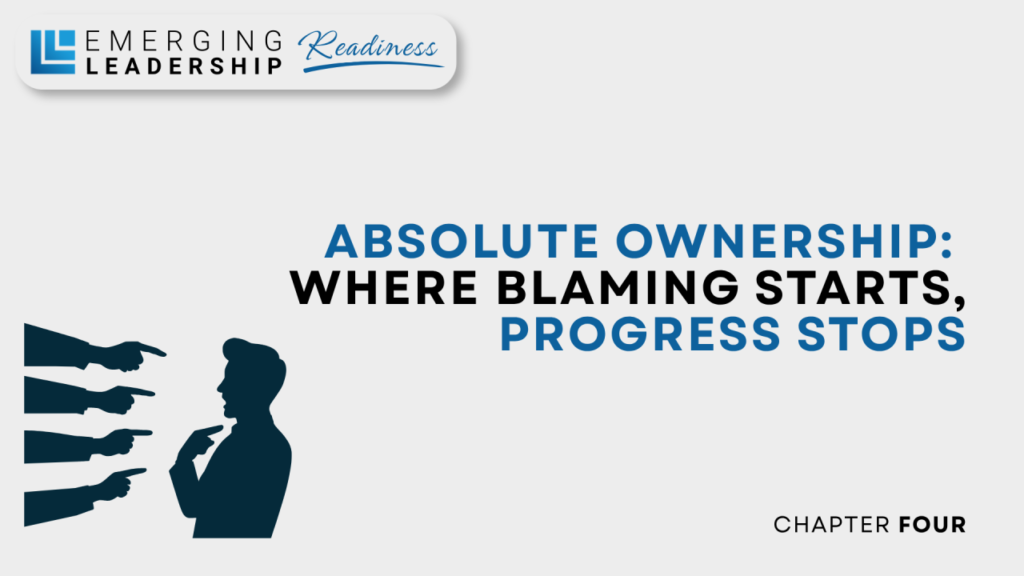
Non-ownership usually sleeps in BED — Blame, Excuse, and Denial. Blame says someone else caused it. Excuse says circumstances prevented it. Denial says, “I did not know.” Different words, same result. The person steps away from the outcome.
Blame sounds like, “The team did not support me,” “The client was not clear,” “Traffic was bad,” or “The other department delayed it.” Excuse sounds like, “I was too busy,” “I did not have time,” “I was not well,” or “I thought someone else would do it.” Denial sounds like, “No one told me,” “I was not aware this was important,” or “I did not understand that this was my role.”
These sentences look harmless. Sometimes they even sound reasonable. But they quietly move a person away from leadership. They shift the focus from “What could I have done?” to “Why it was not my fault.”
That is where progress stops.
There is a simple exercise I often ask emerging leaders to do.
Pick up today’s newspaper, or open any news app, and look at the major stories of the day. You will find delays, failures, accidents, scams, public issues, business problems, governance gaps, customer complaints, and leadership failures.
Then look carefully for one thing.
How many leaders are saying, “I messed up. I am sorry. I take full responsibility. This should not have happened. Starting today, I will personally work on corrective and preventive actions so that this does not happen again.”
You may find many explanations. You may find blame. You may find silence. You may find committees being formed, enquiries being ordered, responsibility being shifted, and statements being carefully worded.
But it is rare to see clean ownership.
Public scepticism is not imagined. The 2025 Edelman Trust Barometer found that 68% of respondents worried that business leaders deliberately mislead people, an increase of 12 percentage points since 2021. This is why accountability matters beyond the immediate mistake. When leaders appear to conceal, minimise or redirect responsibility, they do not merely mishandle one incident; they deepen a wider crisis of institutional trust.

That is why ownership is not just an organizational value. It is a leadership crisis.
When people in positions of responsibility do not own what happens under their watch, the damage goes beyond one incident. Trust reduces. People become cynical. Teams learn that avoiding blame is safer than accepting responsibility. And slowly, the culture becomes defensive instead of accountable.
This is why emerging leaders must learn ownership early. Because the way they respond to small failures today becomes the way they will respond to bigger failures tomorrow.
Leadership begins when the sentence changes from “because of them” to “what could I have done differently?” That shift looks small, but it changes everything.
Accountability should not be confused with forced confession. In a fear-driven workplace, people do not necessarily take greater ownership; they become better at concealing risk. Google’s research on effective teams identified psychological safety as essential because people must be able to admit uncertainty, report mistakes and raise uncomfortable issues early. The strongest cultures therefore combine two principles: it must be safe to tell the truth, and it must be unacceptable to walk away from the outcome.
When Ownership Breaks, Trust Breaks
I remember one senior leader I had hired many years ago. He was a DGM-level person with nearly 20 years of experience. He had worked with an MNC in the USA and had moved back to India. At that time, I was heading presales in a large company and had around nine to ten senior people reporting to me.
When I hired him, I expected maturity, ownership, and energy. But over time, I started noticing a pattern. He was not taking responsibility. He was always passing the buck to someone else. There was very little interest, very little energy, and very little willingness to own the outcome.
I gave him feedback. I extended his probation from six months to nine months, hoping that he would change. Then one incident made everything clear.
An important prospective client from the US sent him a query. He was working on that account. The client wanted information about our India team’s capability in data warehousing for healthcare. I was unwell and at home that day.
He called me for support. I had the data, so I sent him an internal email with the capability document and case studies. I wrote, “Here is the capability document with case studies. You can share this with the client. Let me know if you need any more information.”
What I expected was simple. He had to understand the client’s need, use the material, prepare a proper response, and take ownership of the communication. Instead, he simply forwarded my email as it was to the client and wrote, “See answer below and contact Amit for more information.”
All our internal conversation was shared with the client.
That was not a small mistake. That was a clear indication that he had not taken ownership of the response, the relationship, or the credibility of the organization. At that moment, he lost total credibility in my eyes. My credibility was also at stake in front of my manager.
I had to let him go the next day.
This is the hard truth about ownership. Lack of ownership may look like a behaviour issue, but beyond a point, it becomes a trust issue. Once trust breaks, capability alone cannot save you.
Trust is often treated as a cultural abstraction, but its effects are operational. In PwC’s 2024 survey, executives identified productivity, quality, operational efficiency and profitability as the principal business risks arising when employees do not trust their organisation. The reverse is equally relevant: when leaders cannot trust an employee’s judgement, communication or handling of a stakeholder relationship, the person’s technical capability becomes increasingly difficult to deploy.

That is why ownership is not just an organizational value. It is a leadership crisis.
When people in positions of responsibility do not own what happens under their watch, the damage goes beyond one incident. Trust reduces. People become cynical. Teams learn that avoiding blame is safer than accepting responsibility. And slowly, the culture becomes defensive instead of accountable.
This is why emerging leaders must learn ownership early. Because the way they respond to small failures today becomes the way they will respond to bigger failures tomorrow.
Leadership begins when the sentence changes from “because of them” to “what could I have done differently?” That shift looks small, but it changes everything.
Accountability should not be confused with forced confession. In a fear-driven workplace, people do not necessarily take greater ownership; they become better at concealing risk. Google’s research on effective teams identified psychological safety as essential because people must be able to admit uncertainty, report mistakes and raise uncomfortable issues early. The strongest cultures therefore combine two principles: it must be safe to tell the truth, and it must be unacceptable to walk away from the outcome.

A founder may say, “My team is not performing.” But ownership asks deeper questions. Who hired the team? Who trained them? Who gave them clarity? Who reviewed progress? Who allowed low standards to continue? Who kept the wrong person in the wrong role for too long?
A founder may say, “Leads are not growing.” But ownership asks whether the team is working with the right data, whether the systems are strong, whether the strategy is clear, and whether the founder has created the right environment for success.
Founders often complain that their team does not take ownership. Sometimes they are right. But sometimes, the team is also reflecting the ownership gaps of the founder.
This is where ownership becomes uncomfortable. It asks us to look at our role in the problem before we point to someone else. It does not allow easy escape. It does not allow us to hide behind a polished explanation. It quietly asks, “What could I have done differently?”
That question can hurt. But that question also creates growth.
Ownership Begins With a Different Question
Ownership is the discipline of making the outcome visible, understanding one’s role in it, acting within one’s authority, escalating what lies beyond that authority and staying engaged until the loop is closed.
It is the willingness to stay with the problem long enough to ask, “What is within my control now?” That question brings power back. It does not change the past, but it changes the next action. And sometimes, that is all leadership really is — taking the next right action without hiding behind the wrong excuse.

For emerging leaders, ownership is the bridge between being seen as a dependable performer and being trusted as a future leader.
Without ownership, a person remains useful. With ownership, a person becomes trustworthy.
Without ownership, managers chase. With ownership, managers trust.
Without ownership, the founder carries the weight. With ownership, the leadership team starts carrying the business.
That is why ownership matters so much in the journey of an emerging leader. It is not just another leadership quality. It is the foundation on which clarity, delegation, stakeholder management, decision-making, and execution begin to work. Because if ownership is missing, every other leadership skill becomes weak.
Ownership is not about being perfect. It is about being awake to your role, your choices, your impact, and the cost of your inaction.
So, if you are an emerging leader, pause and ask yourself where you are still explaining more than owning. Where are you waiting to be chased? Where are you saying, “I did my part,” while the outcome is still stuck? Where are you blaming the system, the team, the client, or the founder?
And if you are a founder or senior leader, ask yourself where you are demanding ownership from others without creating clarity, trust, standards, and space for it.
The journey from high performer to emerging leader does not begin when you get people reporting to you. It begins when people stop worrying whether something given to you will be handled. It begins when your manager does not have to chase you. It begins when your stakeholders trust that if something is with you, it will move.
It begins when you stop saying, “This is not my problem,” and start asking, “What can I do to move this forward?”
Ownership is not the willingness to accept blame for everything that goes wrong. It is the refusal to become passive when an outcome is at risk. It is visible in the question asked before confusion grows, the update sent before the deadline is missed, the risk raised before it becomes an escalation and the recovery plan offered before someone demands one.
For employees, it means developing judgement beyond the job description. For managers, it means providing clarity without micromanaging. For founders, it means creating an organisation in which authority and accountability travel together. When these three conditions meet, ownership stops being a word displayed on a wall and becomes a way in which work moves.
Ownership is not a word to be written on the wall; it is a behaviour to be seen when things go wrong — and that is where an emerging leader truly earns trust.
In the next blog, we will explore a hidden leadership skill that quietly shapes careers, relationships, businesses, and sometimes even life itself — the power of making wiser choices.
Till the next blog, keep smiling.
#BusinessClarityCoach #LeadWithClarity #AlignYourTeam #AmplifyImpact #EmergingLeaders #Ownership