It was mid-1993. I was on a software assignment in Berne, Switzerland — just three years into my career, still learning how international clients and unfamiliar cultures worked.
I had scheduled a 10:00 AM meeting with a Swiss colleague, Susan (name changed). We were on the same floor, in the same building, and the meeting room had been booked by me.
At 10:00, I got up from my seat, picked up a coffee on the way, and reached the meeting room. Susan was not there, so I waited. By 10:15, there was still no sign of her, and I assumed she had forgotten.
I walked over to her desk to check. She looked up and said, loud enough for the floor to hear, “I was in the room at 9:59. You were not there at 10:00, and you were the host. So I left. Please reschedule for tomorrow.”
I was deeply embarrassed. There I was, a young Indian professional in a foreign country, feeling publicly corrected and quietly humiliated. In that moment, I simply wanted to flee the scene.
But it was also the first serious lesson I ever learned about time — and it took me years to see that it was never really about punctuality.
Being on time was only the facia. Susan was defending was something deeper: her life. She had set aside a piece of it for that meeting, and she would not let it be spent carelessly.
When I began coaching in 2017, that idea became the very first module I built. Instead of terming it Time Management, I christened it Time Prioritization. The real question is never “how do I fit more in?” It is “do I respect time enough to know where it should be invested?”
For emerging leaders, this question is the be-all and end-all, literally everything. As they grow, the problem is rarely that they have too much work. It is the clear distinction between what’s urgent and what’s important.
Time Is Not Just Time
When I built the module, I knew what I didn’t want it to be. Not another session on matrices, time logs, and planners. Those tools help, but they sit on the surface too.
The reframe was an inspiration from Sadhguru: “What is ticking away is not time, but your life.”

Consider what it does to an ordinary meeting. If someone gives me an hour, I can think, “They gave me an hour.” Or should I can think, “They gave me an hour of their life, which will never return.” The second thought changes everything — how I prepare, how I listen, how seriously I show up.
Even now, if reading this costs you five minutes, you are not giving me five minutes of time. You are giving me five minutes of your life. That makes me responsible for it.
And yet here is the irony I see again and again. A mentee says, “I struggle with time.” I offer a focused session to fix it, and the reply is, “I’m too busy right now — let’s do it later.” Later rarely comes. The person has no time to solve the problem of having no time.

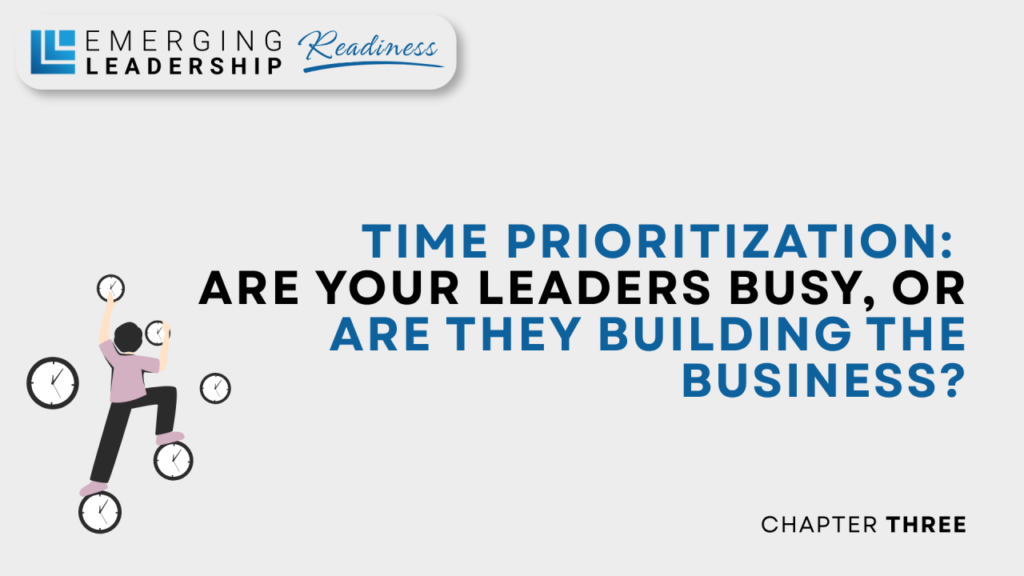
It’s this old cartoon: we push harder without ever pausing to ask whether we’re pushing the right thing.
When Busyness Starts Looking Like Leadership
Most emerging leaders are promoted because they were excellent performers — hands-on, fast, dependable, always available. Post promotion, they continue with the same habits. They join every meeting, review every detail, solve every problem, answer every message, and step in the moment the team wobbles.
At first this looks like ownership. Over time it becomes a trap.
You become the busiest person on the team without being the most effective. Your day fills with activity but not with impact. Sooner than not, a quiet illusion sets in, because busyness camouflages as importance. It makes you feel needed. It whispers in your ears and mind, “I’m doing a lot.”
But leadership is measured by what moves because of you, not by how much you do.
A strong performer asks, “How do I finish more?” A leader has to ask, “What needs to move, and who needs to grow for it to move?” That shift is hard, because many emerging leaders still draw their identity from doing. They feel valuable when they solve, safe when they control, useful when people bring them every small decision.
The very habit that made you a great performer can also make you a weak leader. The title changes; the time pattern doesn’t. That is where the problem hides.

Why Urgent Work Keeps Defeating Important Work
The deepest cost of poor prioritization is simple: urgent work keeps winning. Urgent is loud — it calls, escalates, pings, demands. Important work is quiet.
People development doesn’t shout. Thinking time doesn’t shout. Building your second line doesn’t shout. Yet these are exactly the things that create future strength.
So leaders stay trapped in the urgent, solving today’s problems without ever building the capability to shrink tomorrow’s. The founder keeps getting pulled in, the leader stays overloaded, and the team stays dependent. Work moves, but capability does not grow.
This is one of the quietest ways an organization slows down. No one is idle. No one refuses work. Everyone is busy — and the business still feels heavy. That is movement without momentum.
The Delegation Traps
The biggest reason capability doesn’t grow is weak delegation, which usually fails in two ways. It is also one of the biggest reasons emerging leaders lose time – not because they are lazy or inefficient, but because too much work stays stuck with them.
The first is delegating the same way to everyone – one style, one level of follow-up, one expectation. But people aren’t the same. A quick way to read this before you hand over any task is the Skill–Will lens: look at the person, not just the work, and ask how skilled they are and how willing.
• Low skill and low will needs close direction – clarity, checkpoints, handholding, support.
• High will but low skill doesn’t need doubting; it needs teaching the skill that is low.
• High skill but low will doesn’t need training; it needs the work connected to why it matters, and
• High skill with high will needs only a clear outcome and the trust to step back. Constant checking there reads as mistrust — like grown children asked “have you done it yet?” one too many times.
So delegation isn’t one standard act. It’s a judgment about who this person is today. When that judgment is missing, leaders either over-supervise or under-support — and both end up wasting time.
The second trap is more personal: the fear of letting go. Many emerging leaders became important precisely because they did the work themselves — clients called them directly, juniors leaned on them, founders trusted them. That recognition felt good, and it quietly became part of their identity.
Then they’re promoted, and now the job is getting work done through others. They look at a task and think, “I’ll do it faster.” They see a struggling junior and think, “Why waste time explaining? I’ll just finish it.” It looks like efficiency. But this is where a lot of their time quietly disappears – in doing work that should have already moved to someone else.
But underneath, letting go can feel like losing control — even losing importance. So the reasons arrive: “the team isn’t ready,” “quality will suffer,” “it’s too urgent to delegate.” Some of that is true. But sometimes instead of protecting quality, the leader land up protecting identity.
Here is the shift that matters most in this entire piece. A high performer feels powerful when people depend on them. A leader becomes powerful when people grow because of them.
If you can’t make that shift, delegation will always stay weak and soon the team learns to stop stretching, because they know you’ll take the work back.
So here is one concrete place to start this week. Pick one task you would normally take back, find where that person sits on the Skill–Will lens, and give them the matching support instead of the rescue. Twenty minutes of teaching today removes that task from your plate for good.
The Seed of the Solution: Subtraction, Not Apps

The real solution doesn’t start with a productivity app. It starts with awareness — looking honestly at where your time actually goes.
A few questions surface fast:
• Who really controls my time?
• Where am I spending too much, and too little?
• What, or who, interrupts me most?
• What can I eliminate, and what can I delegate?
They look simple, but they reveal what the calendar hides.
I once asked a mentee these questions, and her answers were unsparing.
• Who controls my time? Office work and my leader.
• Where am I spending too little? My Child and Self.
• What can I eliminate? Office.
That last answer startled even her. It hadn’t come from logic; it came from somewhere deeper. What she saw wasn’t a time problem – it was that her life was being consumed by something that no longer matched what mattered most.
The honest answer to “what should not be in my day?” was the whole job. Not long after, she resigned from her lucrative job for a role with remote work and a saner balance.
That is the point — not that you should resign, but that prioritization, taken seriously, is the discipline of subtraction. It asks not “how do I fit more in?” but “what should not be here at all?” Most days that removes a meeting. Once in a while, it removes a career that stopped fitting.
There are two further questions I find powerful:
• What would I do with an abundance of time? and,
• What would I do with only 24 hours left?
The first reveals desire, and the second reveals priority. Together they expose what we keep postponing in the guise of being busy.
How you spend time is a mirror of what you actually value. If you say people development matters but never make time for it, it was only a nice thought. If you say strategy matters but react all day, then strategy isn’t protected. The mirror doesn’t lie.
The Real Shift: From Doing More to Creating More
So the journey of an emerging leader isn’t about doing more work. It’s about creating more outcomes — and that demands a different relationship with both time and people.
Invest time where it creates the most leadership value. Develop people so the work stops returning to you. Protect important work before urgent work eats the day. Use delegation to build capability, not just to offload tasks.
That is the real shift: from busy to effective, from doing everything yourself to creating outcomes through others, from reacting to your day to designing it.
And for founders, this is one of the clearest signs to watch in an emerging leader. Do they use time like a senior employee, or invest it like a future leader? The test was never how full the calendar is. It’s whether their time creates clarity, capability, and movement.
Because what is ticking away is not time. It is your life.
And leadership begins the moment an emerging leader learns to invest it wisely.
Till the next blog, keep reading, keep smiling.
#BusinessClarityCoach #LeadWithClarity #AlignYourTeam #AmplifyImpact #EmergingLeaders #Time